
Cheddar corn pudding is a spoonable Thanksgiving side with sweet corn kernels, a savory egg custard, and a lightly golden top. It sits between a vegetable side and a soft casserole, giving a holiday plate something creamy without using boxed cornbread mix. Sharp cheddar and chives keep the flavor savory while a small amount of sugar rounds out the corn.
This recipe makes eight side portions in a two-quart baking dish. Allow fifteen minutes of preparation, forty to fifty minutes of baking, and a ten-minute rest. The full planning estimate is about seventy-five minutes. It is an original proposed recipe rather than a kitchen-tested formula, so pan shape and your oven may change the timing.
The center should set into a tender custard rather than bake dry like bread. A little movement is different from a liquid middle, and an instant-read thermometer helps distinguish appearance from doneness. The egg dish should reach 160°F in the center; reheated leftovers need 165°F.
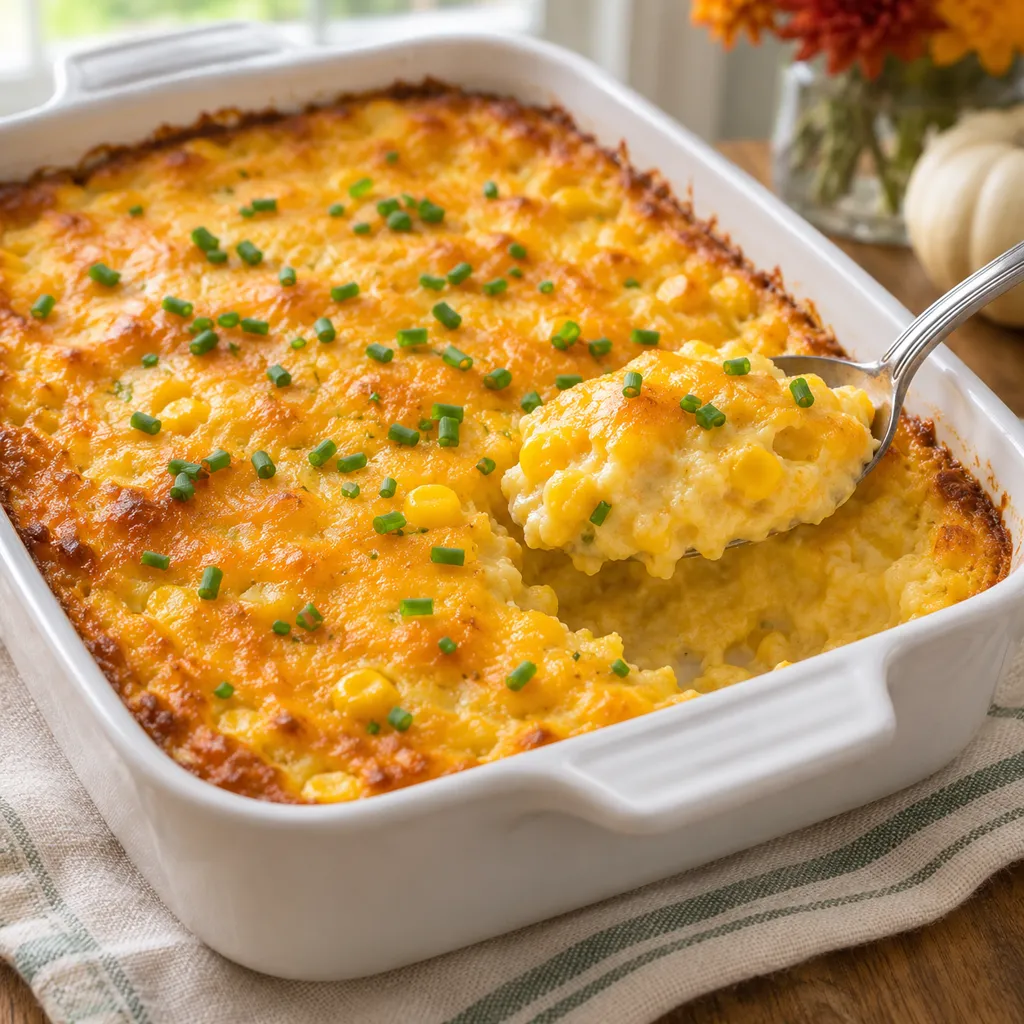
Corn pudding versus corn casserole
Recipe names vary among households, so there is no single boundary everyone follows. In this version, corn pudding means a dairy-and-egg mixture that binds corn into a soft, spoonable side. It uses a little flour for structure but no corn muffin mix. The result should not be expected to have the crumb of a cornbread casserole.
That distinction helps when choosing a place for it on the menu. If you already have stuffing and dinner rolls, a custardy corn side adds a different texture. If you want a firm square that can be lifted like bread, choose a recipe developed for that style rather than reducing the liquids in this one at random.
Serve modest portions with turkey, green vegetables, and cranberry sauce. The cheddar makes the pudding satisfying, so it does not need another heavy cheese topping. Its mild flavor also suits a smaller roast-chicken dinner after the holiday, using the same basic dish and timing cues.
Choose corn and control its moisture
Thawed frozen corn is a convenient base because it is available consistently and easy to measure. Thaw it safely, drain it, and pat away surface moisture before adding it to the custard. Excess water changes the liquid balance and can make the center seem loose even after the edges have overcooked.
Canned whole-kernel corn can be used after thorough draining. Measure the drained kernels rather than assuming every can contains the same usable quantity. Creamed corn is not a direct substitute for whole kernels because it brings additional liquid and a different consistency. Using it would require a separate formula.
Fresh corn is another possible variation when available. Remove kernels carefully, keep the quantity consistent, and recognize that sweetness and moisture differ among ears. Avoid adding the liquid scraped from the cob without accounting for it. The point is to keep the recipe's measured custard, not to add every possible corn component automatically.
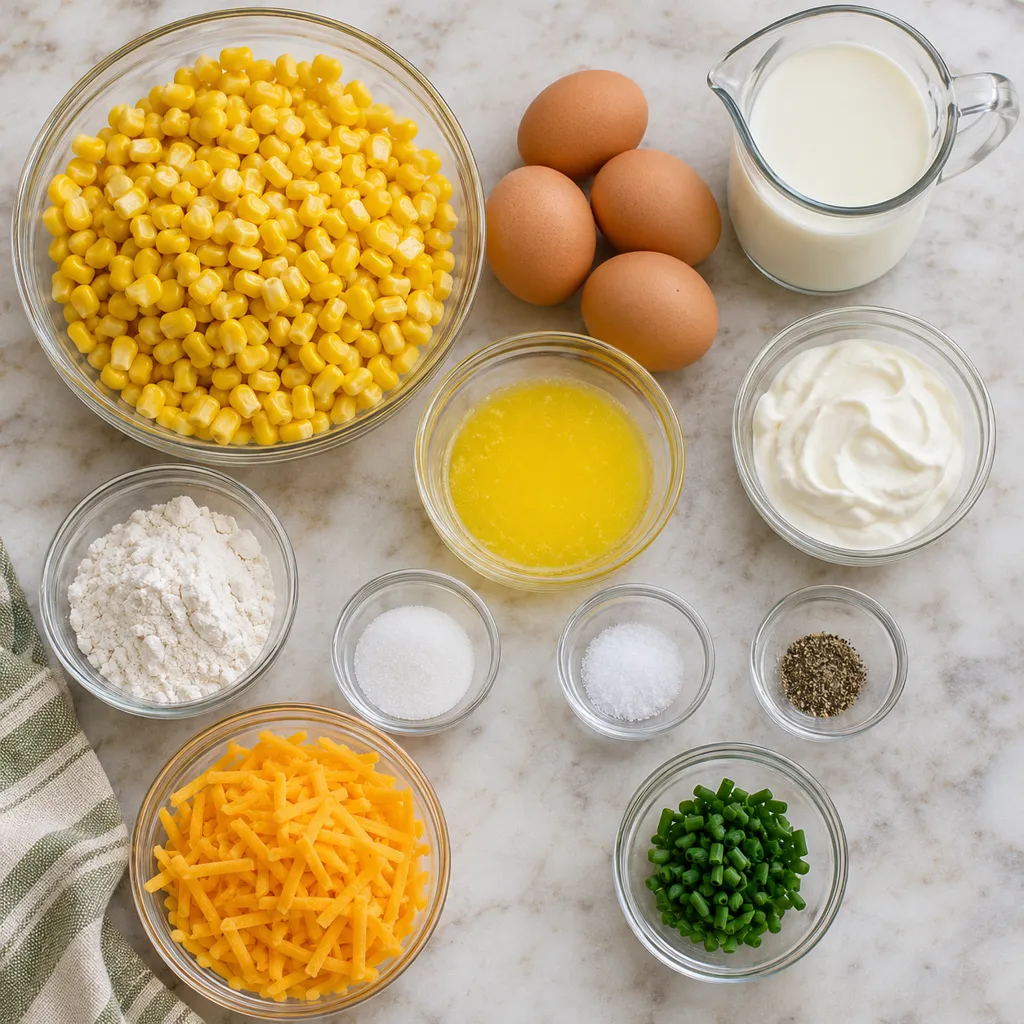
What builds the custard
Eggs provide the main structure. Whole milk and sour cream make the mixture rich enough to stay tender, while cooled melted butter contributes flavor. Whisk the wet ingredients thoroughly so there are no isolated pockets of sour cream or egg. This is particularly useful when the sour cream is thick straight from the refrigerator.
The butter should be melted but not piping hot when it meets the eggs. Very hot butter can begin cooking small pieces of egg and make the mixture uneven. Let it cool until warm and fluid, then whisk it in. There is no need to leave dairy and eggs at room temperature for a long period to accomplish this.
The quarter cup of flour supports the custard, and a tablespoon of sugar adds a restrained sweetness. Do not assume that removing every bit of flour or adding several extra eggs creates the same dish. Those changes affect the set. Keep the first batch close to the proposed formula before making major structural substitutions.
Choose cheddar and chives for a savory finish
Sharp cheddar supplies noticeable flavor without requiring a large quantity. Grate it into manageable shreds so it distributes throughout the corn. Pre-shredded cheese can work, but products differ in coatings and melting behavior. Avoid treating a very salty or strongly flavored cheese as identical without tasting the overall seasoning.
Chives contribute a gentle onion note and small green flecks. Chop them finely rather than leaving long pieces tangled through the custard. If they are unavailable, the pudding can be made without them; a large amount of raw onion is not an equal replacement because it adds moisture and needs its own cooking consideration.
Keep the top simple for the first batch. The base already contains cheddar, so a thick additional layer can hide the center and make judging doneness harder. A few reserved chives after baking are enough if you want to emphasize the savory character at serving.
Mix the pudding without leaving dry flour
Grease a two-quart baking dish and heat the oven to 350°F, or 175°C. A dish of the intended capacity matters because a very deep layer cooks differently from a shallow one. Leave enough headroom for the custard to move slightly as it bakes, and set the dish on a stable oven rack.
Whisk the eggs, milk, sour cream, and cooled butter first. Add flour, sugar, salt, and pepper, whisking until no visible dry flour remains. Scrape the bottom and corners of the bowl. Small flour pockets can be missed if you only stir the surface, and they will not improve by being poured into the baking dish.
Fold in the corn, cheddar, and chives once the custard is combined. Stir gently so the kernels are distributed rather than concentrated in one corner. Transfer to the dish and level the surface. This is a quick mixing process, not a batter that needs prolonged beating or aeration.
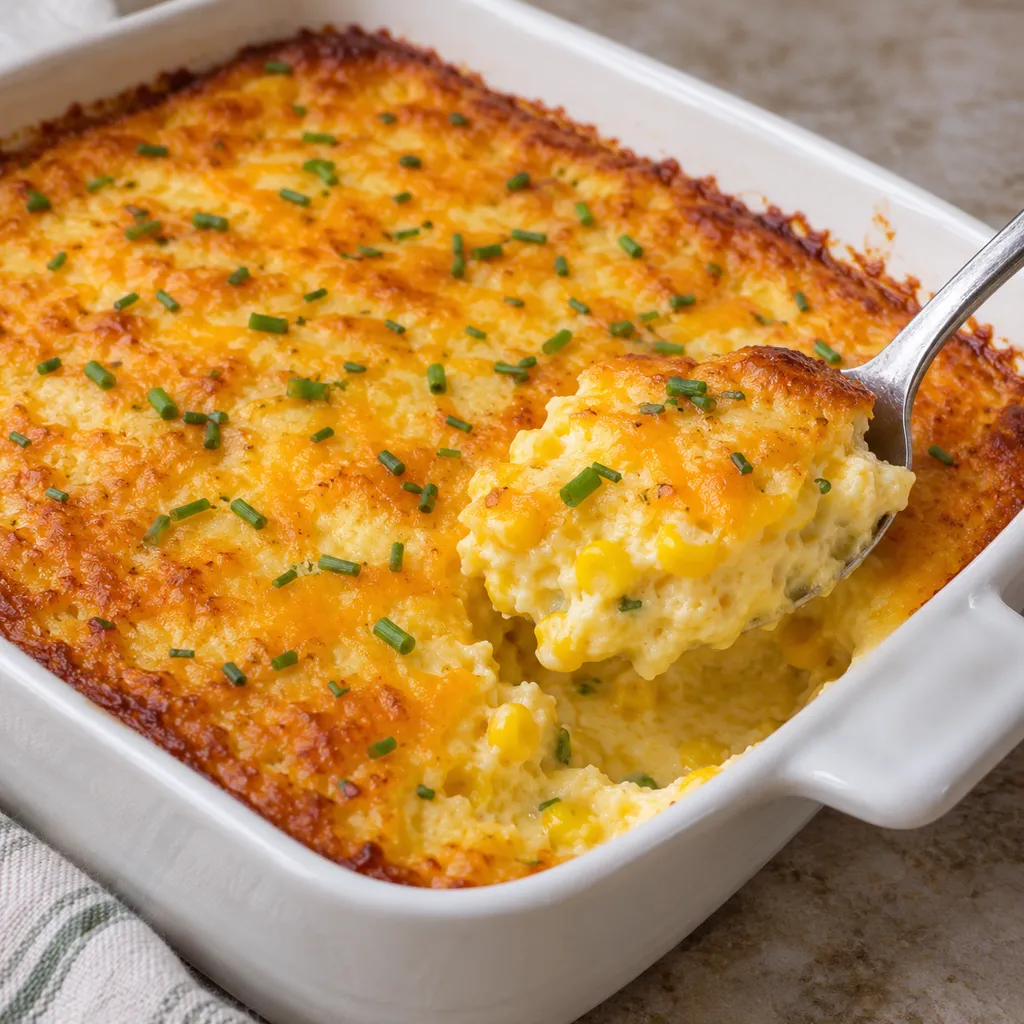
Bake until the center is set
Bake for roughly forty to fifty minutes, checking toward the early end if your dish is shallow. The edges should look set and lightly golden, while the center has a gentle custard wobble rather than a sloshing liquid movement. Insert a food thermometer near the center without touching the bottom of the dish.
An egg dish should reach 160°F. If the top colors before the middle is ready, loosely shield it with foil and continue checking. Do not remove the pudding solely because the surface looks attractive. Conversely, baking far beyond the point of a properly set center can make the custard dry around the edges.
Let the pudding rest for about ten minutes before spooning. The pause makes portions easier to serve and allows the bubbling edges to settle. Resting does not replace adequate cooking. If the middle is still clearly liquid or below the safe temperature, continue baking rather than expecting the rest to solve it.
Make-ahead options for Thanksgiving
The easiest advance work is measuring dry ingredients, grating cheese, thawing and drying corn, and selecting the baking dish. Keep perishable components refrigerated. You can then whisk and assemble without needing to organize every ingredient while the turkey is being carved or guests are arriving.
For a fully cooked make-ahead option, bake the pudding, divide it into shallow containers for prompt cooling, and refrigerate within the safe holding limit. Reheat covered in a suitable oven dish until the center reaches 165°F, then uncover briefly if you want the surface less soft. A cold portion will need more time than a freshly mixed pudding.
Do not rely on a universal reheating time for a deep chilled casserole. Temperature, depth, dish material, and portion size all affect it. Follow the baking-dish manufacturer's guidance about temperature changes, especially with glass or ceramic. A safe reheating plan is more useful than a promise that every dish will be ready in exactly twenty minutes.
Fit the pudding into a one-oven menu
This pudding uses a moderate oven, while crisp roasted vegetables often need higher heat. Schedule it in a compatible window rather than putting every side in together and expecting the original times to remain accurate. If it shares space with another dish, leave room for air circulation and check both foods independently.
The ten-minute rest gives a short serving interval, but it is not an unlimited holding method. For a longer delay, use appropriate hot holding or refrigerate and reheat according to a safe plan. Avoid repeatedly switching between the counter and a warm oven without tracking time and temperature.
For a larger group, make two similar dishes rather than one very deep oversized pudding. Doubling ingredient quantities does not mean doubling baking time, and a much deeper center can lag behind the edges. Two dishes also make it easier to keep one safely stored while a smaller portion is served.
Substitutions and common texture problems
If you need a gluten-free version, use a suitable tested recipe or a carefully chosen gluten-free flour blend and expect some texture change. The small amount of flour still has a purpose. Do not label the dish gluten-free simply because most ingredients are corn and dairy; check every ingredient and preparation surface.
Replacing whole milk with a thinner beverage and removing sour cream can change richness and set. A dairy-free version also needs alternatives for butter and cheese. Treat that as a separate adaptation rather than promising that several exchanges will behave exactly like the original custard.
Watery pudding often points to wet corn, an undercooked center, or a dish deeper than intended. Dry pudding usually reflects too much baking or an altered liquid ratio. Grainy patches may indicate poorly combined ingredients. Diagnose the specific problem before adding more flour to every future batch.
Storage and safe leftovers
Use a clean spoon for serving and refrigerate leftovers in shallow containers within two hours, or one hour if the air temperature exceeds 90°F. Keep the refrigerator at 40°F or below. Use the refrigerated pudding within three to four days of preparation, including any day it was made ahead.
Reheat leftovers to 165°F and check the center. Individual portions often warm more evenly than a full deep dish. Add only a small splash of milk if a portion looks dry; flooding it does not restore the original custard. Freezing can change the texture, so refrigerating a modest batch is the more predictable option for a nearby meal.
Frequently asked questions
Can I make cheddar corn pudding ahead?
Yes. Prepare components ahead or bake, cool promptly in shallow containers, and refrigerate. Reheat the cooked pudding to 165°F before serving. Allow time based on the actual dish depth and temperature rather than assuming a refrigerated casserole follows the fresh-bake schedule.
How do I know the center is fully baked?
Look for set edges and a center that gently wobbles without sloshing. Check with a food thermometer; the egg dish should reach 160°F. A browned top alone cannot establish that the middle is ready, especially in a deep dish or a crowded oven.
Can I use canned corn instead of frozen?
Yes, if it is whole-kernel corn that has been thoroughly drained. Measure the kernels after draining. Creamed corn brings a different liquid balance and is not a direct replacement. Keep the listed milk and egg amounts consistent when making the straightforward canned-kernel variation.
Is this the same as a cornbread casserole?
No. This version is a spoonable corn-and-egg custard with a little flour and no boxed cornbread mix. Family naming traditions vary, but the expected texture here is tender and creamy rather than a firm bread-like square. Choose a different formula if that firmer result is what you want.
Cheddar Corn Pudding: A Creamy Thanksgiving Side Dish
By Raelynn · Original proposed recipe
Ingredients
Instructions
- Heat oven to 350°F (175°C). Grease a 2-quart baking dish.
- Whisk eggs, milk, sour cream, and cooled melted butter. Whisk in flour, sugar, salt, and pepper until no dry flour remains.
- Fold in corn, cheddar, and chives. Transfer to the prepared dish.
- Bake 40–50 minutes, until edges are golden and center is set with a slight wobble, not liquid; an egg dish should reach 160°F (71°C) in the center. Rest 10 minutes. Total estimated time including rest is 75 minutes.
Original proposed recipe; not kitchen-tested. All times are estimates. Scaling changes ingredients only; cooking time, temperature, pan space, and doneness still need attention. Total includes a 10-minute rest. Cook egg pudding to 160°F (71°C); reheat leftovers to 165°F (74°C).
Food safety references
FoodSafety.gov: safe cooking and reheating temperatures; FDA: egg safety.
You might also like these recipes
Cheddar Corn Pudding: A Creamy Thanksgiving Side Dish
Crispy Parmesan Brussels Sprouts for Thanksgiving
One-Pan Chicken Pesto Gnocchi with Spinach